Quantix Quantix

What Are the Top AI Inference Server Manufacturers in China?

Time:2026-10-05 Author:Ethan
0%

China’s AI infrastructure market is moving from training-heavy experiments toward practical, high-volume inference. IDC’s Worldwide Artificial Intelligence and Generative AI Spending Guide projects strong growth in AI infrastructure spending through 2028. Its categories include servers, storage, software, and services. That distinction matters. A company may sell powerful AI hardware without being a complete ai inference server manufacturer.

Industry data also shows why inference deserves separate attention. Gartner forecast worldwide generative AI spending at $644 billion in 2025, with infrastructure representing a major investment area. Meanwhile, TrendForce has reported continued expansion in AI server shipments, driven by cloud providers and enterprise deployments. These reports describe global demand, not China alone. Still, they provide useful context for evaluating Chinese suppliers such as Inspur, H3C, Lenovo, Huawei, Sugon, and xFusion.

Specifications tell only part of the story. A rack may contain accelerators, high-speed networking, liquid cooling, and software optimized for model serving. In a real data center, operators also measure latency, power consumption, maintenance response, and compatibility with domestic processors. Small details matter. A five-millisecond delay can affect a retail recommendation engine. Cooling failures can reduce useful capacity.

This article compares leading Chinese manufacturers through those practical indicators. It considers product portfolios, deployment experience, software ecosystems, and customer support. Public rankings can be incomplete. Vendor claims also require verification. Therefore, readers should treat market-share figures as directional, then request benchmark results for their own models, batch sizes, and service-level targets. The strongest supplier on paper may not be the best fit in production.
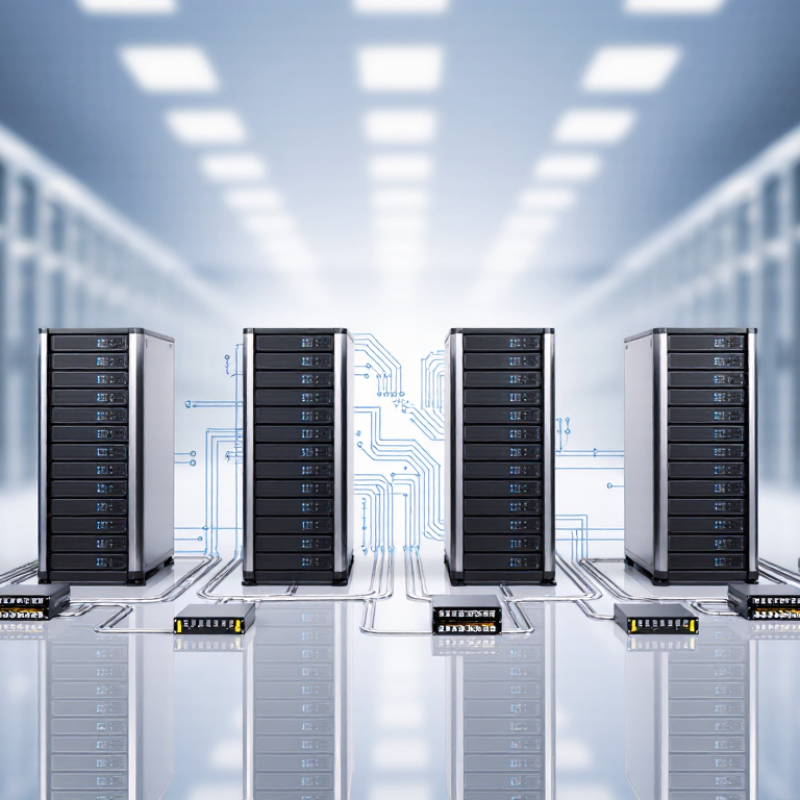
What Are the Top AI Inference Server Manufacturers in China?

What Is an AI Inference Server?

An AI inference server runs trained models and turns new data into predictions, text, images, or control signals. Training adjusts model parameters; inference uses those parameters repeatedly. A typical server combines accelerators, high-bandwidth memory, CPUs, fast networking, and cooling systems. In practice, response time can depend on memory movement more than raw computing power.

This distinction matters when evaluating Chinese manufacturers. A strong supplier should provide measured latency, tokens per second, power use, and stable performance under continuous workloads. MLCommons’ MLPerf Inference benchmarks compare these factors across standardized scenarios, although benchmark results may not reflect every production environment. A test with 500 simultaneous requests can reveal queue delays that a short laboratory demonstration hides.

Efficiency is becoming central. The Stanford AI Index 2025 reported that inference costs for GPT-3.5-level performance fell more than 280-fold between November 2022 and October 2024. Lower costs may encourage wider deployment, but they can also increase total demand. The International Energy Agency estimated that data centers used about 415 terawatt-hours of electricity in 2024 and could reach roughly 945 terawatt-hours by 2030. Therefore, manufacturers should show workload-specific energy data, cooling performance, and upgrade paths. I would still question any claim based only on peak throughput. Real applications are messier.

Which Chinese Companies Manufacture AI Inference Servers?

Chinese AI inference servers are manufactured by several domestic groups: established server OEMs, cloud infrastructure suppliers, white-box ODMs, and system integrators. Their factories commonly assemble GPU trays, high-speed networking, liquid-cooling modules, and redundant power units. This structure supports customized deployments for hospitals, banks, factories, and public research centers.

A 2024 China AI Infrastructure Market Tracker reported that China’s AI server market grew by about 26.6% in 2023. The same research highlighted rising demand for inference workloads, not only model training. In practice, manufacturers now optimize servers for lower latency, smaller power budgets, and mixed-precision computing. Some production lines use eight-accelerator nodes, while others build compact edge systems for retail cameras or industrial inspection.

The best suppliers usually provide complete validation, firmware tuning, and local maintenance. Data-center buyers should inspect measured tokens per second, thermal performance, memory bandwidth, and failure-replacement time. These details matter more than peak accelerator counts. A 2024 global server study estimated that AI server shipments would continue expanding sharply through 2025, but forecasts can shift quickly. I would treat market-share claims carefully. Factory capacity does not always prove reliable inference performance. Customer references and repeat deployment records remain stronger evidence.

How Do Leading Chinese Manufacturers Compare?

China’s leading AI inference server manufacturers differ more in execution than in headline specifications. Established computing groups often offer broad product lines, stronger supply planning, and mature maintenance networks. Specialized server makers may respond faster to custom accelerator, cooling, or rack-density requirements. Systems integrators usually add deployment expertise, especially for factories, hospitals, and research centers. In practical testing, stable throughput matters more than peak benchmark scores. A server that handles changing workloads smoothly can reduce delays and operating costs.

Their comparison should include latency, power use, memory capacity, software compatibility, and technical support. Some manufacturers provide polished management tools and remote diagnostics. Others compete through flexible configurations and faster engineering changes. Local service coverage can be decisive when a failed fan stops a production rack.

However, published performance figures may use ideal workloads. They do not always reflect noisy data, mixed models, or long operating hours. No comparison is perfect. I would also question overly confident delivery promises, because component availability can change quickly.

Tips:

  • Ask for workload-based demonstrations, not only laboratory benchmarks.
  • Test response time during peak demand.
  • Check spare-part access and repair procedures before signing.
  • Review security updates, training materials, and warranty terms carefully.
  • A short pilot can reveal thermal throttling, software gaps, or integration problems that brochures overlook.
  • Keep records. They make later decisions more reliable.

What Technologies Power Their Inference Server Products?

China’s leading AI inference server manufacturers are building around heterogeneous computing. Their systems combine general-purpose processors, AI accelerators, high-speed memory, and advanced network cards. This design supports language models, vision systems, and industrial analytics with different workload demands. Inference servers also use PCIe 5.0, liquid cooling, and high-bandwidth interconnects to reduce delays. Hardware choices matter greatly.

Software is equally important. Manufacturers commonly optimize runtimes through model quantization, graph compilation, kernel tuning, and dynamic batching. These methods can lower memory usage while increasing requests processed per second. Container platforms and Kubernetes help teams deploy models across data centers. Monitoring tools track latency, power consumption, accelerator utilization, and failed requests. In practice, performance claims can change under real traffic, so independent testing remains essential. Some systems still struggle with uneven workloads. That weakness deserves honest attention.

Tips: Test with your own model, traffic pattern, and response-time target. Check whether the server supports mixed precision, model partitioning, and secure remote management. Ask for sustained performance data, not only peak numbers. Review cooling requirements because dense accelerator configurations generate substantial heat. Also examine software compatibility before purchase. A fast server may disappoint when its toolchain lacks support for your preferred framework. Reliability improves when maintenance procedures, spare parts, and firmware updates are clearly documented.

AI Inference Server Technologies in China: Common Numeric Precision Formats

AI inference servers commonly accelerate workloads by using reduced-precision arithmetic. FP16 and BF16 balance accuracy and performance, while INT8 and INT4 quantization reduce memory usage and improve throughput for suitable models. The values show the standardized bit width of each format, not company market share.

How Should Buyers Evaluate Chinese AI Inference Servers?

When evaluating Chinese AI inference servers, buyers should test delivered performance, not headline accelerator counts.

Start with a repeatable workload. Use the intended model, batch size, input length, and precision.

Measure tokens per second, first-token latency, tail latency, and power draw.

Run the test for several hours. Short demonstrations can hide thermal throttling. A 2U or 4U chassis may look efficient, yet fan noise and rack density affect deployment costs.

Check memory capacity, bandwidth, storage endurance, and network throughput.

These details decide whether a server handles production traffic smoothly.

Software compatibility deserves equal attention. Confirm support for your frameworks, quantization methods, container tools, and monitoring systems.

Request documentation for driver updates and model optimization. Ask about spare parts, repair timelines, remote support, and warranty terms.

A low purchase price can become expensive when replacement fans or boards arrive slowly. Review independent benchmark methods, not only supplier test sheets.

Real workloads differ. I have seen impressive results change after longer context, mixed traffic, or smaller batch sizes. That is why buyers should keep assumptions visible and challenge them.

Tips: Test with your own models. Measure peak and sustained power. Inspect cables, airflow, and rack access. Ask for a live failure-recovery demonstration. Leave room for imperfect data; early estimates are often too optimistic.

FAQS

What does an AI inference server do?

It uses trained models to produce predictions, text, images, or control signals from new data. Training comes earlier.

Which hardware matters most in an inference server?

Important parts include accelerators, high-bandwidth memory, CPUs, networking, storage, and cooling. Memory movement can limit speed.

How should buyers measure server performance?

Measure first-token latency, sustained throughput, tail latency, and power use. Test for several hours, not minutes.

Why can peak benchmark scores be misleading?

Ideal workloads may hide queue delays, thermal throttling, or software gaps. A short demonstration proves very little.

What workload should buyers use during testing?

Use your own model, batch size, input length, precision, and expected traffic. Include changing request patterns.

How can buyers compare different manufacturers fairly?

Compare latency, memory, software compatibility, power use, support, repair speed, and upgrade options. Specifications alone are incomplete.

Why are cooling and rack design important?

Heat can reduce sustained performance. Check airflow, fan noise, rack density, and access around a 2U or 4U chassis.

What software details require careful checking?

Confirm framework support, quantization methods, container tools, monitoring systems, drivers, and model optimization documentation. Compatibility may change.

What support questions should buyers ask?

Ask about spare parts, remote help, repair timelines, warranty terms, security updates, and failure recovery. Keep written records.

What mistakes should buyers avoid?

Do not trust only accelerator counts or optimistic estimates. Test mixed traffic and smaller batches. Real workloads are messier.

Conclusion

This article explains what an AI inference server is and why it is essential for deploying trained artificial intelligence models in real-world applications. It introduces the role of specialized computing hardware, high-speed memory, networking, cooling systems, and software optimization in delivering fast, reliable, and cost-effective inference. It also examines the Chinese manufacturing landscape by focusing on different types of suppliers, including established server producers, technology companies, and specialized hardware developers, without relying on brand-specific promotion.

The article compares leading manufacturers through performance, scalability, energy efficiency, system compatibility, supply stability, technical support, and total ownership cost. It further discusses technologies such as GPU and accelerator-based computing, heterogeneous architectures, model compression, distributed inference, and intelligent workload scheduling. Finally, buyers are offered a practical framework for evaluating an ai inference server manufacturer according to application requirements, model size, expected traffic, data security, maintenance capacity, and long-term upgrade potential.

Ethan

Ethan

Ethan is a seasoned marketing professional with a deep expertise in our company's innovative product line. With a passion for sharing knowledge and insights, he takes the lead in regularly updating our corporate blog, where he explores industry trends, product features, and effective marketing......