Choosing the right AI infrastructure partner can shape a model’s speed, cost, and reliability. This guide examines the top 10 AI training server manufacturers worldwide through practical, measurable criteria. It focuses on GPU density, cooling design, networking, software support, warranty coverage, and global service capability.
A credible ai training server manufacturer must deliver more than impressive specifications. Its systems should sustain heavy workloads without frequent thermal throttling or unstable power delivery. Details matter, including rack compatibility, liquid-cooling options, memory capacity, and firmware update policies. A research team may need eight GPUs for computer vision, while a language-model project could require hundreds of accelerators across multiple racks.
Performance is not the only measure. We also consider deployment experience, technical documentation, energy efficiency, and customer support. Some manufacturers excel in custom configurations, while others offer stronger supply chains or broader enterprise integration. No ranking is universally correct. Regional availability, import requirements, electricity costs, and engineering skills can change the best choice.
Real-world testing can expose weaknesses that product brochures omit. A server might post excellent benchmark results yet become difficult to maintain in a crowded data center. That possibility deserves attention. We compare established global brands with specialized providers, using public specifications, industry reputation, and practical purchasing considerations. Readers should verify current configurations before ordering, because GPU generations, prices, and delivery timelines change quickly. The result is a balanced starting point, not a permanent verdict.
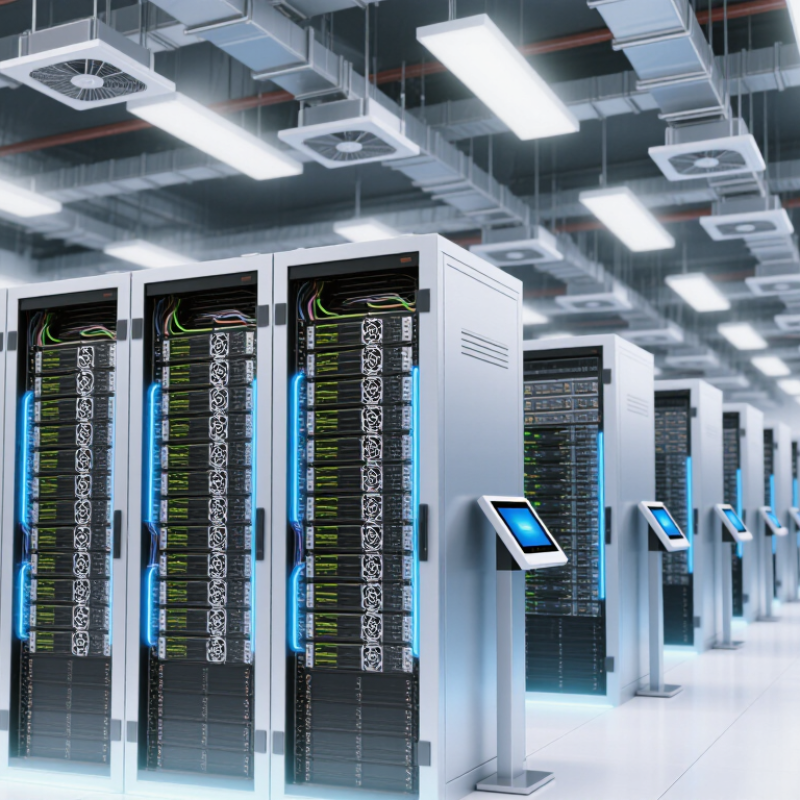
AI Training Servers: Definition, Purpose, and Core Components
AI training servers are specialized computing systems built to teach machine learning models from large datasets. Unlike ordinary business servers, they prioritize parallel processing, memory bandwidth, and rapid data movement. In practice, a training workload may involve thousands of images, speech files, or text records. The server repeatedly adjusts model parameters until predictions improve. This process demands stable performance during long, intensive sessions. A short benchmark can mislead. Real workloads expose thermal limits, software errors, and storage bottlenecks.
Core components usually include accelerator cards, multi-core processors, high-capacity memory, fast storage, and high-speed networking. Accelerators handle matrix calculations efficiently, while processors coordinate data preparation and system tasks. Memory capacity matters because oversized datasets can force repeated transfers, reducing utilization. Solid-state storage shortens loading time, but it cannot fix poorly organized data pipelines. Network fabric connects servers for distributed training. Power supplies, cooling systems, and monitoring tools are equally important. Quiet operation is not guaranteed.
The purpose is not simply to produce a larger model. A well-designed server improves training speed, repeatability, and cost control. Administrators should measure throughput, energy use, failure rates, and recovery time. Security controls also protect datasets and access credentials. I have found that balanced configurations often outperform impressive but mismatched specifications. Still, hardware alone cannot solve weak data quality or unclear evaluation methods. That limitation deserves honest attention. The best design depends on model size, workload patterns, budget, and future expansion plans.
Criteria for Comparing AI Training Server Manufacturers
Comparing AI training server manufacturers requires more than counting accelerators. A credible review starts with workload evidence, not marketing claims. Ask whether published benchmarks match your model size, batch settings, and data pipeline. Numbers can mislead.
Hardware balance matters. Examine accelerator memory, host processors, system memory, storage speed, and high-bandwidth networking. A powerful accelerator may underperform when data arrives slowly. Check thermal design in realistic conditions, including rack density, airflow, noise, and power limits. Liquid cooling can improve capacity, but it may add maintenance requirements. Firmware quality, driver compatibility, and monitoring tools also deserve careful testing.
Reliability should be measured over time. Request failure-rate data, burn-in procedures, spare-part policies, and response targets. Independent certifications and transparent test methods strengthen manufacturer credibility. Support engineers should understand distributed training, not only replace components. Compare warranty terms, deployment services, energy costs, and upgrade paths across the server’s expected life. Total cost often changes after installation.
I would also inspect a demonstration system before signing a large contract. A short trial can reveal unstable drivers, slow recovery, or unexpected power draw. No scorecard is perfect. Weight each criterion according to your workload, team skills, and facility limits. A manufacturer with slightly lower peak performance may deliver better results through stable software, clear documentation, and dependable support. Measurements still need independent verification.
Criteria for Comparing AI Training Server Manufacturers
Standard Ethernet link rates provide one measurable point of comparison for the high-speed networking used in AI training clusters.
The chart shows standardized Ethernet rates, not manufacturer rankings or a guarantee of server performance. When comparing systems, also check accelerator count, memory capacity and bandwidth, interconnect options, power and cooling requirements, and support for scaling across multiple servers.
Global Distribution and Market Position of Leading Manufacturers
The global market for AI training servers is distributed across manufacturing hubs, regional integrators, and local service partners. Leading manufacturers compete not only on computing capacity, but also on delivery, maintenance, and access to compatible components. Buyers in North America, Europe, and Asia may face different lead times and support arrangements. A powerful system is less useful if replacement parts take weeks to arrive. Local expertise matters.
Market position is difficult to judge from performance figures alone. Large suppliers may serve research centers and cloud operators, while smaller specialists can offer more flexible configurations. Their standing also depends on power efficiency, cooling design, software compatibility, and the ability to scale deployments. Published specifications rarely show the whole picture. Independent testing and customer references can help, though comparisons are not always like-for-like. That can be frustrating.
Tips: Compare regional service coverage before choosing a supplier. Ask for realistic delivery estimates, warranty terms, and expected power use under sustained workloads. Check whether the proposed configuration supports your existing networking and storage. A short pilot can reveal thermal or workflow issues that a brochure misses. Record actual performance; early assumptions sometimes prove wrong.
Top 10 AI Training Server Manufacturers Worldwide
AI training server manufacturers worldwide compete on more than accelerator count. Their systems must keep processors, memory, and high-speed networks working together under sustained loads. A dense rack can draw tens of kilowatts, so power delivery and cooling design matter as much as peak benchmark results. Small details count. Cable routing, service access, and firmware updates can affect uptime across a large cluster.
A useful comparison of ten manufacturers should examine measured training throughput, supported accelerator configurations, and the time needed to replace a failed component. Ask how systems behave during long runs, not just short demonstrations. Check whether cooling options match the data center and whether local technicians can provide timely support. Manufacturing scale and supply-chain resilience also shape delivery schedules. Rankings can change quickly as hardware generations and regional availability shift. There is no perfect scorecard; published performance figures may use different software settings, and buyers should verify claims with workloads close to their own. A brief test can still miss problems that appear after weeks of operation.
Top 10 AI Training Server Manufacturers Worldwide
Vendor-neutral comparison criteria for evaluating manufacturers. No company names, brands, or unsupported rankings are included.
| Evaluation criterion |
What to verify |
Why it matters for AI training |
| Accelerator support |
Supported accelerator models, quantity per system, and validated configurations |
Determines compute capacity and compatibility with the intended training software. |
| Interconnect topology |
GPU-to-GPU links, PCIe generation, and supported network adapters |
Fast communication helps distribute training workloads across accelerators and servers. |
| System memory |
Memory capacity, channel configuration, and supported memory type |
Adequate host memory supports data loading, preprocessing, and workload orchestration. |
| Local storage |
Drive bays, supported NVMe options, and storage-controller configuration |
High-throughput storage can reduce delays when reading datasets and writing checkpoints. |
| Network connectivity |
Available Ethernet or InfiniBand adapters, port speeds, and fabric compatibility |
Multi-node training depends on reliable, high-bandwidth server-to-server communication. |
| Power requirements |
Power-supply capacity, redundancy, input requirements, and measured system power |
Power availability and efficiency affect data-center planning and operating costs. |
| Cooling design |
Air-cooling limits, airflow requirements, and liquid-cooling options where offered |
High-density accelerator systems generate substantial heat and require suitable cooling infrastructure. |
| Software validation |
Operating-system support, accelerator drivers, firmware, and validated software stacks |
Validated components can simplify deployment and help reduce compatibility issues. |
| Service and lifecycle support |
Warranty terms, regional service coverage, replacement-part availability, and firmware updates |
Support responsiveness influences system availability throughout its service life. |
| Configuration transparency |
Published bills of materials, performance test methods, and workload-specific results |
Comparable, clearly documented configurations make procurement decisions more reliable. |
Key Technologies Shaping the Future of AI Training Servers
AI training servers are evolving from powerful computers into carefully balanced systems. Their performance depends on processors, accelerators, memory, networking, and cooling working together. A fast accelerator can still sit idle if data arrives too slowly. That bottleneck is easy to overlook.
High-bandwidth memory keeps large datasets close to compute units, while high-speed interconnects move data between servers with less delay. This matters when teams train models across many machines. Power use matters, too. Liquid cooling can remove heat from dense racks more effectively than traditional airflow, but it adds plumbing and maintenance requirements. Practical designs weigh these trade-offs rather than chasing peak specifications.
Software is another key technology. Scheduling tools can distribute workloads, track accelerator use, and reduce wasted capacity. Efficient storage helps teams feed training jobs without repeated delays. Operators should also monitor temperatures, power draw, and network congestion under real workloads. Benchmarks help, but they do not tell the whole story. A system that looks excellent in a test may behave differently in a crowded data center. Even mature designs have rough edges. Careful testing remains essential.
Conclusion
AI training servers are specialized computing systems designed to process the large datasets and complex workloads used to develop and refine artificial intelligence models. Their performance depends on coordinated components such as accelerators, processors, high-speed memory, storage, networking, and thermal management. Comparing an ai training server manufacturer involves looking beyond peak computing power to factors such as system scalability, compatibility, reliability, energy efficiency, service support, and the ability to adapt configurations to different workloads.
Manufacturers serve markets across multiple regions, with their positions shaped by engineering capabilities, production capacity, customer needs, and distribution networks. A worldwide comparison of leading suppliers can therefore consider both technical strengths and the practical demands of operating large-scale computing environments. The future of AI training servers will be influenced by advances in accelerator design, faster interconnects, improved cooling, efficient power use, and software that helps systems work together. These developments aim to make training infrastructure more capable, scalable, and efficient.
 Quantix
